

|
 |
|
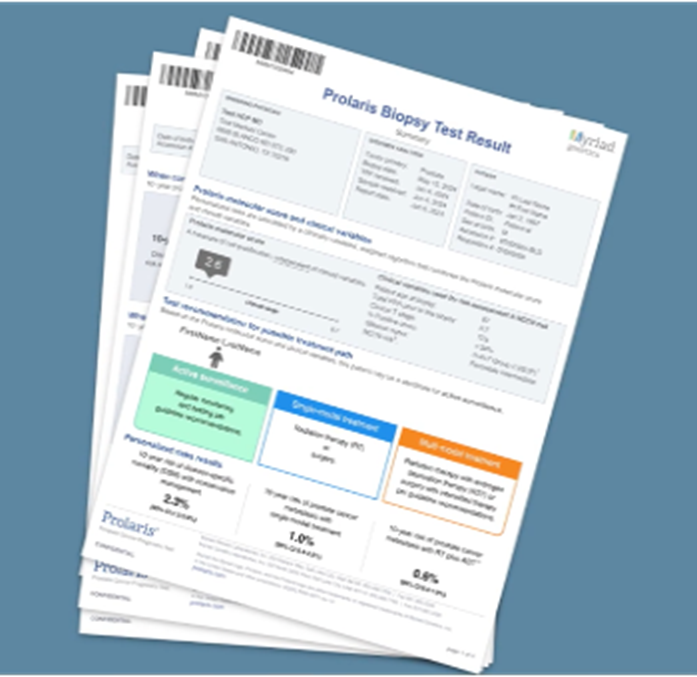
| View a sample Prolaris Test report. |
Why the Prolaris Test stands apart:
- Outperforms all other biomarkers in identifying appropriate candidates for active surveillance (1,2)
- Validated in untreated patients, making it uniquely suited to help make initial treatment decisions (1)
- In a pivotal study, no patients below the active surveillance threshold died from prostate cancer (1)
- Helps influence treatment decisions in up to 65% of cases in real-world clinical practice (3,4)
- Patients recommended for active surveillance by the Prolaris Test are twice as likely to choose it (5)
Confidence for clinicians and patients
The Prolaris Test reports are designed to be clear, actionable, and easy to share—helping clinicians explain complex genomic insights in a way patients can understand. This transparency builds confidence and supports shared decision-making, ensuring patients feel informed and empowered.
When active surveillance is on the table, choose the test built for it. Choose the Prolaris Test.
Order now
References:
- Lin DW, Crawford ED, Keane T, et al. Identification of men with low-risk biopsy-confirmed prostate cancer as candidates for active surveillance. Urol Oncol. 2018;36(6):310.e7-310.e13.
- Hu JC, Tosoian JJ, Qi J, et al. Clinical Utility of Gene Expression Classifiers in Men With Newly Diagnosed Prostate Cancer. JCO Precis Oncol. 2018;2:PO.18.00163.
- Shore ND, Kella N, Moran B, et al. Impact of the Cell Cycle Progression Test on Physician and Patient Treatment Selection for Localized Prostate Cancer. J Urol. 2016;195(3):612-618.
- Crawford ED, Scholz MC, Kar AJ, et al. Cell cycle progression score and treatment decisions in prostate cancer: results from an ongoing registry. Curr Med Res Opin. 2014;30(6):1025-1031.
- Lenz L, Clegg W, Iliev D, et al. Active surveillance selection and 3-year durability in intermediate-risk prostate cancer following genomic testing. Prostate Cancer Prostatic Dis. 2025;28(2):427-434.

Announcements

Introducing LUGPALearn: Explore. Learn. Earn CME.

Learn how to have your facility become a SRC/NAFC Center of Excellence In Continence Care for Women.
LUGPA groups will receive a discount on certification fees.
LUGPA members can login to access past content On Demand.